← All Services
Forex & CFD Payments

Card acquiring for forex,
that actually approves.

The majority of acquirers auto-decline forex, CFD, and prop-trading merchants — and the few who say yes often impose punitive rolling reserves and slow settlement cycles. IceTree connects you directly to a small group of acquirers running active forex programs: fair reserves, realistic settlement, and risk teams who already understand your business model.

Get Matched to a Forex Acquirer
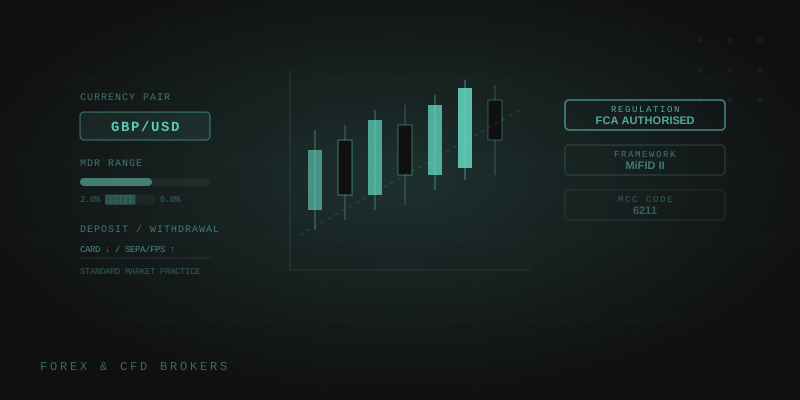
Forex and CFD payment processing solutions for brokers
Forex Application Reality
BY ACQUIRER TYPE
Generic high-street acquirer
Auto-decline
Mainstream PSP, generalist
Declined at risk team
Standard "high-risk" acquirer
20–25% rolling reserve
Forex-experienced acquirer
Approved, fair terms

IceTree skips the first three rows. We go directly to row four.

WHAT'S INCLUDED

The forex payment stack, properly assembled.

Forex-Active Acquirers Only

We maintain relationships with the handful of acquirers running live forex/CFD programs — regulated EU credit institutions, UK-authorised payment institutions, and offshore acquirers with documented broker policies.

Sensible Rolling Reserves

Forex/CFD merchants are routinely quoted 20–25% rolling reserves over 270 days. We negotiate based on your actual chargeback ratio and AUM stability — typical outcomes are 10–15% with documented reduction milestones.

Faster Settlement

Standard forex offers settle on T+7 to T+14 cycles. We push for T+2 to T+5 where your chargeback profile and volume justify it — reducing the working capital tied up in pending settlements.

Multi-Regulator Setup

FCA-authorised, CySEC-regulated, ASIC, FSA, or offshore — placement depends on your licence and where you onboard customers. We work across EU, UK, and tier-1 offshore jurisdictions.

WHY FOREX KEEPS GETTING DECLINED

Forex isn't risky.
Wrong acquirers are.

A regulated forex broker with proper KYC, sensible leverage, and a clean chargeback profile is a perfectly underwriteable business — for an acquirer that knows the vertical. The 95% decline rate comes from approaching acquirers who don't.

MCC 6211 (security brokers) is flagged high-risk by every mainstream acquirer
Forex chargebacks (often friendly fraud after losing trades) misread as fraud signals
High average ticket size triggers manual review at every level of the schemes
Regulatory complexity across FCA, CySEC, ASIC requires specialist underwriting
Prop trading firms with retail-facing entry fees sit in a separate risk category
Acquirers without live forex programs decline to avoid scheme reporting exposure

FAQ

Common questions answered.

Three structural reasons: (1) MCC 6211 (security brokers) is flagged high-risk by every mainstream acquirer, (2) forex chargebacks — often friendly fraud after a losing trade — look identical in scheme reports to genuine fraud, and (3) high average ticket size triggers manual review at multiple layers. The result: even fully regulated brokers face decline rates above 90% when applying to acquirers without active forex programs.

Standard market quotes for forex/CFD start at 20–25% rolling reserve held for 270 days. IceTree typically negotiates 10–15% with documented step-downs at 6, 12, and 18 months — based on your actual chargeback ratio and AUM stability. Reserves above 15% past month 18 indicate the wrong acquirer was selected.

Yes — and prop trading firms with retail-facing entry/evaluation fees are a distinct underwriting category from B2C forex brokers. Some acquirers will underwrite prop trading specifically while declining traditional forex; others do the inverse. Placement depends on your fee structure, evaluation model, and any payout liabilities to traders.

Significantly. FCA-authorised, CySEC-regulated, and ASIC-licensed brokers face different underwriting tiers. Offshore licences (SVG, Mauritius, Vanuatu, BVI) further narrow the acquirer pool but are still placeable with the right partners. We assess your licence stack and customer onboarding geography before approaching the market.

Yes. The market default for forex/CFD is T+7 to T+14, but acquirers with active forex programs can offer T+2 to T+5 when your chargeback profile and volume justify it. Faster settlement materially reduces working capital tied up at the acquirer — for a high-volume broker, the difference between T+14 and T+3 can mean millions in unlocked liquidity.

Most forex-active acquirers require £500K–£2M monthly processing minimums. Pre-launch brokers or those running below the minimum often need to build initial volume via alternative payment methods (open banking, bank transfer, crypto on-ramps) before applying for card acquiring. We can advise on this staged approach.

Skip 20 declined applications.

Book a free consultation. Share your licence, jurisdiction, and volume profile. We'll come back with a shortlist of forex-active acquirers — at no cost to you.

We use cookies to analyse site performance and measure the effectiveness of our outreach. Privacy policy